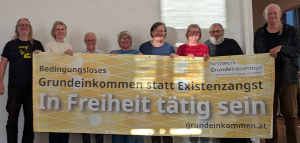
Workshop: Basic Income for Artists - Ireland as a Model
- When: Thursday 10. September 2026, 13:30
- Where: Ursulinenhof Linz, Landstraße 31, Gewölbesaal, As part of the Ars Electronica in Cooperation with GrundeinkommenAttac
Registration: Registration Ars-Electronica
After a successful pilot program, Ireland now has a UBI for artists. With UBI there is some basic security for artists that allow them to create art with a bit more freedom and independence from commercial considerations. With some input directly from Ireland we will hear how this is working.
- Caelainn Hogan (Online, Artist from Ireland)
- Narcy Calamatta (Artist from Malta)
- Evelyn Dawid (Researcher Austria)
- Requested: Ministry of Arts Austria
Moderation: Franz Schäfer (Mond)
Open Discussion with the audience and the artists.
Articles:
- Nora Soumah: Ein Grundeinkommen für Kulturarbeit in Irland and on the page of IG-Kultur (in German)
- Guardian Caelainn Hogan
Related event: AI and Property Relations: Who Owns Our Collective Knowledge?
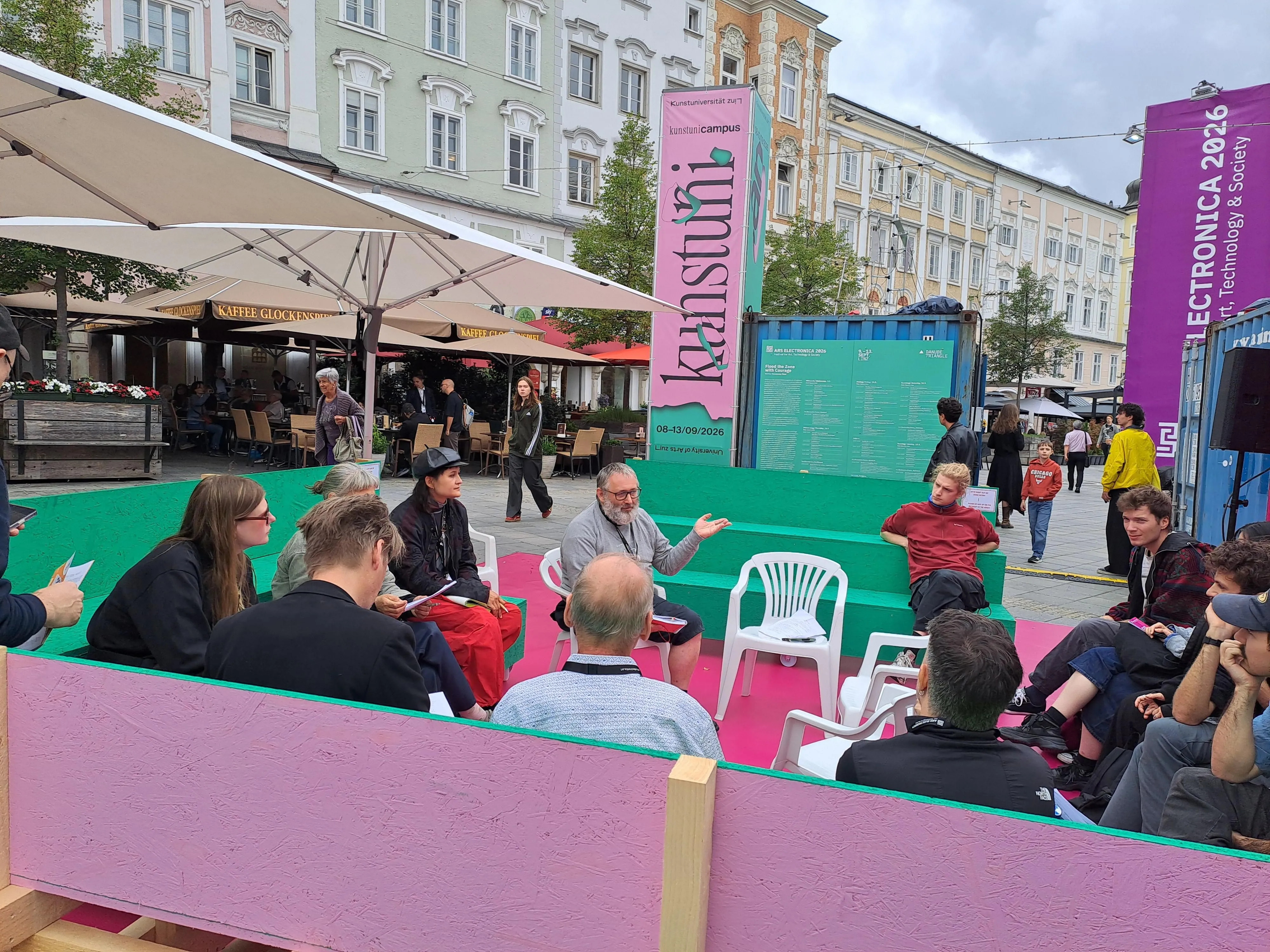
Short report from the workshop "AI and Property Relations: Who Owns Our Collective Knowledge?"
While the left has ignored the AI topic for a long time, pretending it is not "real" and only a "stochastic parrot", the issues caused by AI can no longer be ignored. One of the 3 core questions at the heart of the issue is: Who owns these AI models? Who controls them?
As these models have been trained with all of humanity's knowledge, we have a moral argument to say that these models should belong to all of us. One way to do this would be to demand that these models have to be released as open source/open weights (after some initial, independent safety testing).
This would prevent that any one company could control these systems and would also take out the main motive for the arms race: If a model has to be released to the public anyway, then investing much in its creation does not make that much sense anymore. This arms-race dynamic is responsible for the fact that research into safety and "alignment" is grossly neglected.
Anything that slows down the rapid development is helpful, as currently people and politics cannot keep up with the development.
The fact that these powerful AI models could be used to cause serious harm by, e.g., creating a computer virus or even a biological virus is often brought up as one of the concerns why these models could not be released as open source. While the argument has some merit, it should be clear that not opening it is even more dangerous. We should not expect to get AI systems that are aligned with humanity's interest if the training happens in a competitive, corporate climate. In the end, the capitalist system is not aligned with humanity's values, and the AI systems are a reflection of this.
Currently, these AI companies operate in a legal gray area, and we would have the opportunity to demand the open sourcing of their models, but this would be a collective effort. As artists have to directly live off their artistic production, they have a special interest here.
Already, the strike in Hollywood in 2023 was about the AI topic.
We also had a similar discussion back 20 years ago when the open-source movement argued that society should question the absurd way of making something artificially (by law) rare, just so that it could be traded as a commodity within the capitalist system. Back then, artists were rather opposed to this for obvious reasons. As long as one's livelihood depends on selling your work, you have an interest in this artificial scarcity.
Now in the AI age, each author or artist or musician could individually try to get some compensation out of these AI companies, but the more sensible way would be a collective approach that asks for open sourcing the models.
In the discussions at the workshop, it was refreshing to hear that this idea was welcomed by the participants. While the question of livelihood still needs an answer, there was some consensus that AI needs to be democratically controlled and needs to belong to all of us.
-- Franz Schäfer (Mond), September 2026, More from Mond on AI
Short report from the workshop "Basic Income for Artists - Ireland as a Model?"
Recently, South Korea announced that it would introduce a basic income for artists in 2026, said it was modeled after Ireland, and cited recent advances in AI as a reason.
Ireland had a pilot project for a basic income for artists that has recently been made permanent. The payout is currently limited to 2,000 artists who are selected by lottery among the eligible applicants. Currently, artists can only get it for a period of 3 out of 6 years. The basic income is €325 per week.
The costs of living are especially high in Ireland due to extremely high costs of housing. As many artists threatened that they would leave Ireland because they could not afford this, the government was forced to come up with a solution. We had Caelainn Hogan via a live connection to Ireland, and one of the artists who was negotiating the basic income deal with the Irish government joined our workshop.
The workshop was promoted to be a "highlight" of the program, so we were a bit afraid that it would be a crowded event. But all in all, we were a small group that had a lively discussion about the topic.
We discussed the precarious situation of artists. Evelyn David supported this with actual numbers, as she had done a study on the situation of artists in Austria.
Due to the limited time, we could only touch on the topic of what Adorno calls the "culture industry" - how much the production of art and culture is poisoned by the need to be able to sell it as a commodity.
While artists are in a precarious condition, of course they are not the only group in our society that has to struggle. From Ireland, we heard that the model there already created discussions in other groups of society that are also demanding a basic income. Peter mentioned farmers here.
So, while the model in Ireland certainly has its flaws, it serves as a beacon for many others.
With artists from many different countries in the room, we concluded the event by exchanging email addresses and creating an email list. Narcy from Malta (who was scheduled to give input but could unfortunately not attend) is on there too and has already announced that he will pressure the government in Malta with the information from Ireland.
And then we have the European Citizens' Initiative for an Unconditional Basic Income in the EU that starts in January of 2027. With all the discussion around AI gaining momentum, we hope to reach the 1 million signatures.
It is encouraging to see that this workshop could be the seed for some actual change.
-- Franz Schäfer (Mond), September 2026